





In commercial projects, the selection of interior doors is never based solely on aesthetics. These components play a central role in safety, regulatory compliance, occupant comfort, and the durability of the building. Whether it is an office building, a retail space, an institutional facility, or a multi-unit residential building, doors must meet specific standards established by the National Building Code and various recognized certifications.
This guide outlines the main standards that apply to interior doors in commercial projects, with a focus on fire resistance, soundproofing, accessibility, regulatory compliance, and the role of Intermat in selecting certified and compliant products.
The Regulatory Framework for Commercial Projects
In Canada, the requirements that apply to interior doors in commercial buildings are primarily governed by the National Building Code of Canada (NBC), which is adopted and adapted by each province. The code aims to ensure:
-
Occupant safety
-
Fire protection
-
Universal accessibility
-
Functional performance of buildings
Doors are an integral part of compartmentalization, circulation, and evacuation systems. Non-compliant doors can lead to construction delays, costly corrections, or even failed inspections.
Fire-Rated Doors: A Key Element of Safety
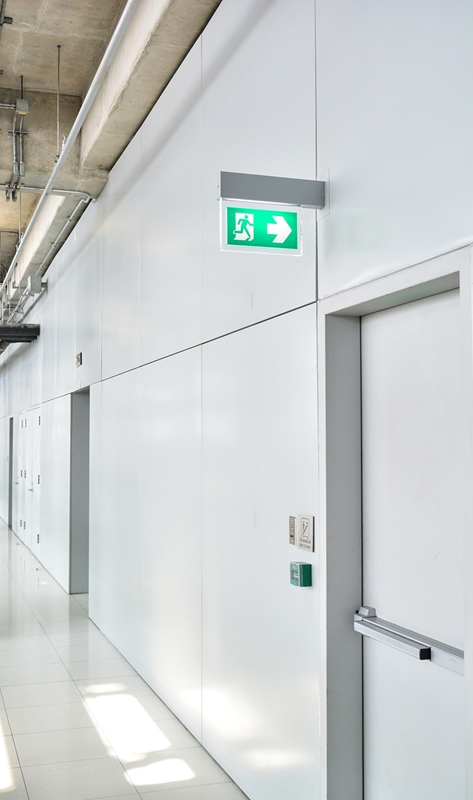
In commercial projects, many interior doors must provide fire resistance to help limit the spread of flames and smoke.
When is a fire-rated door required?
Fire-rated doors are generally required:
-
In exit corridors
-
Between high-risk areas (technical rooms, stairwells, mechanical rooms)
-
Between different fire compartments
Relevant standards
Fire-rated doors must be tested and certified according to recognized standards, including:
-
CAN/ULC-S104 – Fire Tests of Door Assemblies
-
NFPA 80, often used as a complementary reference for installation and maintenance
Doors are classified according to their fire resistance duration (20, 45, 60, 90 minutes, etc.), which must correspond to the requirement of the wall in which they are installed.
The importance of a complete assembly
A compliant fire-rated door includes:
-
The door leaf
-
The frame
-
Certified hardware
-
Self-closing devices
Even a certified door can lose its certification if it is installed incorrectly or fitted with non-compliant components.
Soundproofing: Comfort and Privacy
In commercial buildings, acoustic insulation is essential to ensure confidentiality, concentration, and occupant comfort.
Common applications
Acoustic requirements are common in:
-
Private offices
-
Meeting rooms
-
Healthcare facilities
-
Hotels
-
Educational institutions
STC rating
The acoustic performance of doors can be expressed using the STC rating (Sound Transmission Class), which measures a component’s ability to reduce airborne noise transmission.
The higher the STC rating, the better the sound insulation. Solid doors, perimeter seals, and acoustic thresholds all play an important role in achieving the desired acoustic performance.
Accessibility: A Regulatory Requirement
Universal accessibility is a critical consideration in commercial projects.
Reference standard
The CSA B651 standard – Accessible Design for the Built Environment serves as a reference to ensure safe and independent access for people with reduced mobility.
Common requirements
Interior doors must generally comply with requirements such as:
-
A minimum clear opening width
-
Maximum opening force
-
Easy-to-use handles (lever handles)
-
Reduced or no thresholds
These criteria apply particularly to public spaces and common areas.
Certifications and Compliance with the National Building Code
To comply with regulations, interior doors used in commercial projects must:
-
Be tested by recognized laboratories
-
Display certification labels (UL, ULC, Warnock Hersey, Intertek, etc.)
-
Be installed according to the manufacturer’s recommendations
Building inspectors rely on these certifications to validate project compliance. Incomplete documentation or non-certified products can lead to compliance issues during inspections.
The Importance of Choosing the Right Supplier
In a commercial context, choosing a specialized interior door supplier is strategic. It is not just about providing a product, but about ensuring:
-
Regulatory compliance
-
Alignment with plans and specifications
-
Availability of solutions adapted to the project
-
Reliable technical support
How Intermat Helps You Choose Compliant Doors
Intermat supports building professionals—contractors, architects, designers, and project managers—in selecting interior doors suited to commercial projects.
Compliance-focused expertise
Intermat offers:
-
Certified products that comply with current standards
-
In-depth knowledge of NBC requirements
Valuable technical support
The Intermat team helps you:
-
Identify regulatory requirements according to the building type
-
Select the right door and frame configurations
-
Ensure consistency between plans, specifications, and installed products
A local partner
Working with a local supplier like Intermat makes it easier to:
-
Communicate effectively
-
Monitor project progress
-
Access technical information quickly
-
Resolve on-site issues efficiently
Relying on Expertise for Compliant and Durable Choices
In commercial projects, interior doors are far more than simple partitions. They contribute directly to safety, comfort, accessibility, and the overall compliance of the building. Respecting current standards is essential to ensure the durability of the project and to avoid regulatory complications.
By relying on certified products and the expertise of a specialized interior finishing supplier like Intermat, building professionals can move forward with confidence, knowing that every installed door meets the expected technical, functional, and regulatory requirements.